Author Archives: Chris Thelen

Unknown's avatar

About Chris Thelen

A current doctoral student in the Educational Policy Program at Michigan State University College of Education, I am interested in everyday experiences of students and educators and how those narratives can be used to shape our discourse about education.

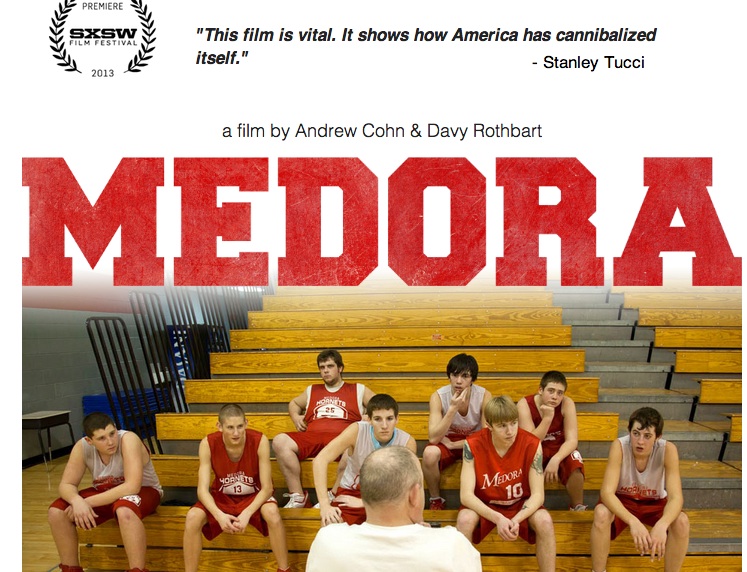
“Medora”: A Team, A School, A Community

medora-film

On this week’s episode of Independent Lens, we see PBS’s answer to March Madness in “Medora.” This documentary, surprisingly produced by Stanly Tucci and Steve Buschemi, relates the struggles of a high school basketball team, and those struggles directly mirror those of its tiny rural Indiana town. The team is the worst in the league. They haven’t won a game in over a year. But they just keep on trying. Basketball in Indiana is akin to football in Texas, and this film has all of the drama of an extended episode of “Friday Night Lights.”

“Medora” isn’t just a sports documentary. It’s about a school and its vital place in a community doing whatever it can to survive the fallout of a decimated local economy. As in so many rural areas, the school is innately tied to the town’s identity. “This town will die when that school leaves,” one local observes. With a swelling budget deficit, the school must consider consolidation, following the lead of all the other districts in the area.

The students and the team are caught in the middle of these politics. They have as many personal problems as the school and town do. I have to wonder if the responsibility for lifting the town up is a burden on the shoulders of these players or if that responsibility makes them stronger. Or maybe it’s both.

This film is difficult to watch at times, but it’s a wonderful reminder that small triumphs matter. Anybody who loves sports and loves schools should take the time to watch it. You can find a link to the entire film below.

http://video.pbs.org/video/2365195424/

Teaching Is Hard Enough Without All the Haters Out There

Image

I just began reading The Inspired Teacher: How to Know One, Grow One, or Be One by Carol Frederick Steele (2009). I came upon it in a rather odd way. My dad was buying gas and a cup of coffee a few weeks ago and somehow struck up a conversation about me with a fellow patron. He mentioned that I had just gotten a degree in educational studies and she, who turned out to be a lecturer at Michigan State University, insisted that I read her book about teaching. My dad scribbled down her name and the book title and relayed them to me that evening.

Having never received any sort of formal teacher training (and very little informal at that), I’ve been wanting to gain some insight on pedagogy for a long time. I’m not sure yet whether this book is what I’ve been looking for, but I appreciate Steele’s desire to help all teachers improve their craft, regardless of their current levels of skill and experience. I’ve been intrigued by her discussion of a set of 8 qualities shared by expert teachers. Her list includes:

a strong sense of mission,
a desire to improve their teaching,
a holistic sense of teaching to develop individuals as well as impart facts,
a high degree of confidence in their own personal and professional views,
a peer support system that reinforces their sense of mission,
a form of support from significant others,
a sense of professional autonomy, and
a refusal to permit interference with their teaching mission.

I couldn’t help but consider how these traits related to the teachers I had while in school. I even went so far as to begin a chart in which I designated certain teachers as particularly good or particularly bad in each respect. Like probably everyone, I had a handful of favorite teachers through the years and a few that I really didn’t care for. It felt good to deeply reflect on my favorites and realize that the qualities on this list are indeed what made them great, or at least contributed to that.

But my analysis brought up some uncomfortable feelings as well. Feelings of guilt. I felt guilty for putting some teachers in the ‘bad’ column, even though I was trying to make an honest assessment. Why did I feel like I needed to do this? How much can I gain from reflecting on what I found to be bad teaching? How much of the big picture might I be missing?

I don’t think I was being unfair in recognizing that some of my teachers could have improved, but I was almost certainly wrong in labeling them as bad. It’s pretty unfair to label someone who has made a career out of an underpaid, usually thankless job as a bad teacher. As Steele points out, many teachers never progress beyond a ‘capable’ level of practice. Some might not believe it’s possible to get better, and some might not feel it’s worth the even greater self-sacrifice that’s required in order to do so.

It’s hard to blame them. The modern teachers’ college focuses on the practice of teaching much in the same way that medical schools train doctors in the practice of medicine. Teacher preparation has only recently taken on this clinical structure, but considering the import of the educator’s task, it certainly seems that saving a child’s livelihood is akin to a doctor saving her life. The American teacher sees only a shadow of the respect garnered by physicians, however. And certainly a mere shadow of the payscale.

As observed by Button and Provenzo (1983), the social prestige of the teaching profession is directly correlated with the difficulty of the material being taught rather than the difficulty of actually teaching that material. Hundreds of years ago, school masters taught Latin, a language that hardly anyone know and thus carried a great deal of prestige. When values shifted toward teaching all children, regardless of class, just enough to read the Bible and perform basic math, teachers’ stock plummeted. Naturally, it fell even further when women got into the profession.

My point is this: even today, society thinks that teaching is easy. They think kindergarten is babysitting, elementary school is a recitation of facts, and secondary school means handing a kid a book to read and a stack of worksheets to fill out. Maybe you’ll get some respect if you’re an astrophysics professor with a PhD. In reality, a college professor never has to worry about a little kid who wet his pants in class. Or a teenager who just won’t put her phone away. Or a middle schooler who somehow never learned how to read. Teaching is so much more complex than knowing one’s subject. It means staying attuned to students and their needs, along with a big dose of introspection.

I ended up reading this book because my dad bought a cup of coffee one day, but I wish I had come across it sooner. Being an inspired teacher is a monumental task, and most people—myself included—need to appreciate that more. A lot of teachers have more work to do and more improvements to make. But so does everybody else.

Further Reading

Button, H. W. & Provenzo, E. F., Jr. (1983). History of Education & Culture in America. Englewood Cliffs, NJ: Prentice-Hall, Inc.

Steele, C. F. (2009). The Inspired Teacher: How to Know One, Grow One, or Be One. Alexandria, VA: Association for Supervision and Curriculum Development.

The Educational Wonder of Pudding

Image

When I was in 1st grade, I got to make pudding at school. In the classroom. Real food that a person could eat. This blew my 7-year-old mind. How could anyone ever possibly be allowed to cook in a school? Kids have rules upon rules set before them with the explicit intent of keeping them from having a good time. But not this time. This time my pint-sized world got turned on its head.

I’m not sure that my teacher thought herself to be a mastermind based on a box of powdered whatever and two cups of milk. Or perhaps the simplicity of it was the genius part. Like cats and a laser pointer. She totally won at teaching that day.

An Open Question: What Are Our Goals For Education?


photo1(4)

One of the most intriguing journal articles I’ve ever encountered is David F. Labaree’s “Public Goods, Private Goods: The American Struggle over Educational Goals.” I cited it in at least half of my graduate essays. I just couldn’t stop thinking about it while I was studying education. Labaree outlines three main goals that America has historically held in educating its young people: democratic equality, concerned with bringing up well-informed, patriotic citizens who are smart enough not to elect a walrus to the state legislature; social efficiency, concerned with producing well-fitting cogs in the industrial machine; and social mobility, concerned with aiding the most skilled and hard-working individuals to get ahead in the workforce and become your boss before they’re old enough to rent a car.

Labaree’s main argument is that our educational system is increasingly shifting toward supporting social mobility and away from a seemingly ideal balance of these three goals. Based on this, I’d like to pose a couple of questions:

Is Labaree’s argument accurate? Is our education really shifting toward a means to individual ends? Or has education always been this way?

And the big question: What should our goals for education be?

I have my own opinions, and so does everyone else. Please feel free to weigh in!


Further Reading

Labaree, D. F. (1997). Public Goods, Private Goods: The American Struggle Over
Educational Goals. American Educational Research Journal, 34(1), 39–81.


The Psychology Behind Terms Like ‘Failing Schools’

Image

It’s a term that we’ve been hearing a lot lately. It’s a term that I’ve used myself. But I never thought twice about it until I was in one of my master’s classes last year. The course was entitled “The Social Context of Schooling.” Usually we discussed the social environment in which teachers run their classrooms, administrators run their schools, and policy makers shape our education system.

That day, however, we turned the lens on ourselves as educational thinkers. We all know that many, many schools are struggling. Struggling to give kids the education they deserve. Struggling to meet the expectations that have been put upon them by AYP and the policies behind it. Many of those schools feel that they are on the chopping block, bound to close, be turned over to the state, or be turned into a charter school.

This limbo is undeniable, but what are the implications of labeling a school as failing, even if that term is informal? My professor urged us to consider the impact that our language can have on our own thoughts and behaviors, along with those of others. She also wanted us to think about how we would feel if the school we worked in or sent our children to had garnered that label. What’s the likelihood that we would feel any power to turn that situation around? Probably pretty slim. What’s the likelihood that we would throw in the towel and accept that if those around us have given up on our school, we probably should too? Probably pretty high.

Talking about the challenges that schools face is essential, particularly in this era of standards and accountability. However, my professor was absolutely right in asserting that we need to show compassion in our thoughts and words. Education is all about building people up. Everyone deserves to feel like his or her school has a fighting chance.

A Very Weird Animal

photo

Ever try to explain charter schools to a Canadian? It’s . . . difficult. There are so many things about the American education system that make it a very weird animal. And just as unique as our one-of-a-kind educational landscape is the educational experience of every single student, parent, educator, and policy maker in America. We all have a story.

I’ve seen a lot of the American educational landscape. But so has just about everybody else in America. That’s what I love so much about education. Try bringing it up at a dinner party sometime, and everyone will have something to say. Or rant. It’s as ubiquitous as the weather and can elicit as much debate as sports, politics, or religion. It can lift us up. It can leave us out. It can give us hope.

Even within a single family, experiences can be incredibly diverse. From my mother’s one-room-schoolhouse to my father’s Catholic seminary (which obviously didn’t work out as planned) to my own urban high school, there are a lot of stories to be told.

There are few forums for the recounting of those stories, though. I want to change that, even if it’s just a little bit. For all of the books and articles and lectures on education, narrative is rare. In a field of practice and research, numbers and data are almost always privileged over personal accounts.

My goal is to bring more voices to the discourse about education. Luckily for me, everyone has something to say.